My name is Mark Carlson.
I am a Ph.D. candidate at Monash University, studying single-agent pathfinding on grids under my supervisors Daniel Harabor and Peter Stuckey. See below for my publications. I also have a strong interest in physically-based rendering.
I write my code in Rust whenever possible; the language is truly a joy to work in.
Current Projects
mkpath
My pathfinding library, focused around providing useful primitives such as node expansion policies and priority queues. It uses a dynamically-constructed node structure whose members are accessed via offset pointers to avoid the “generic type soup” problem alternative designs suffer from.
Recent Blog Posts rss_feed
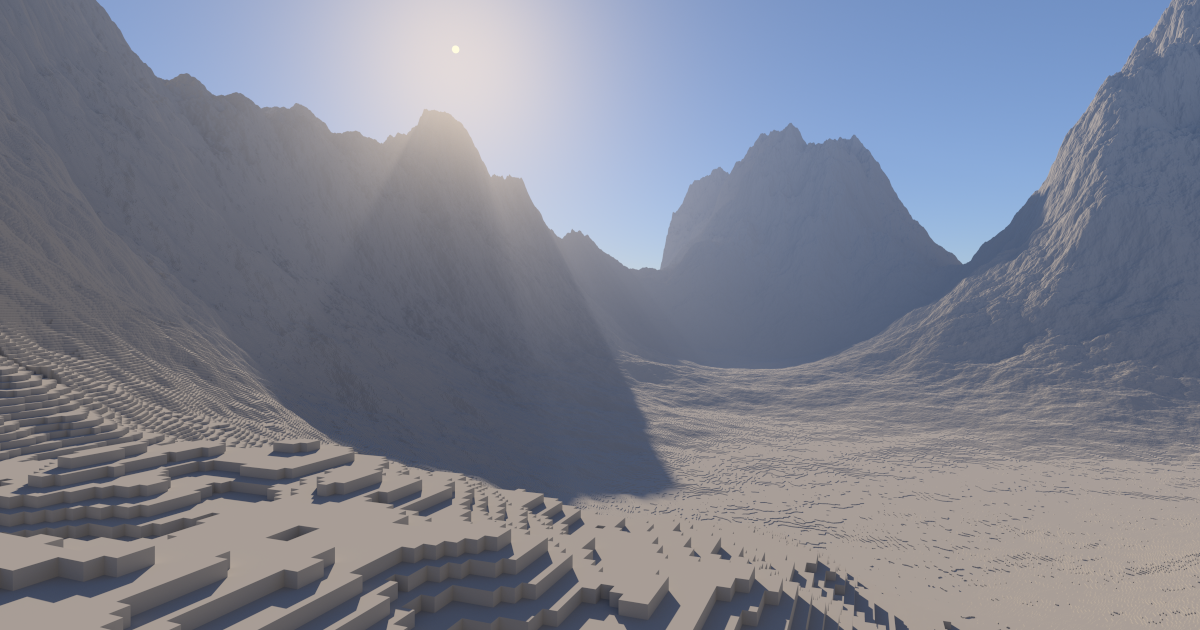
It’s been quite a while since I last updated my website, and it has become rather outdated, so I’ve finally decided to update it.
Publications
All of my publications are Open Access; simply follow the DOI link to the official publication to access the PDF.
- Carlson, M., Moghadam, S. K., Harabor, D. D., Stuckey, P. J., & Ebrahimi, M.
(2023).
Optimal Pathfinding on Weighted Grid Maps.
Proceedings of the AAAI Conference on Artificial Intelligence, 37(10),
12373–12380.
https://doi.org/10.1609/aaai.v37i10.26458
- Carlson, M., Harabor, D., & Stuckey, P. J.
(2024).
Avoiding Node Re-Expansions Can Break Symmetry Breaking.
Proceedings of the International Symposium on Combinatorial Search, 17(1),
20–27.
https://doi.org/10.1609/socs.v17i1.31538
- Carlson, M., Harabor, D., & Stuckey, P. J.
(2025).
Sub-Microsecond Grid Path Planning, at What Cost?
Proceedings of the International Symposium on Combinatorial Search, 18(1),
38–46.
https://doi.org/10.1609/socs.v18i1.35974
- Carlson, M., Harabor, D. D., & Stuckey, P. J.
(2026).
Faster Grid Pathfinding with Approximate Bounding Boxes.
Proceedings of the International Symposium on Combinatorial Search, 19(1),
29–35.
https://doi.org/10.1609/socs.v19i1.43070
Past Projects
ice4
A chess engine designed to fit in 4096 bytes for the Top Chess Engine Championship’s 4K division. It achieves this by decompressing and compiling minified C++ code using a custom minifier. It came first place in the 4kI, 4kII, 4kIV, 4kV, and 4kVI events held from late 2022 to late of 2025. Unfortunately, I have been unable to improve it in a long time, and so ice4 placed second in the 4kVII event in 2026.
Boychesser
A chess engine I helped develop alongside analog hors and several others to compete in Sebastian Lague’s Tiny Chess Challenge in 2023, where we took first place. Competitors were restricted to 1024 tokens of C# for the search and evaluation code. This turned out to be a very different type of restriction than the one imposed by TCEC’s 4K division.
Cold Clear
A modern Tetris versus engine I worked on from August 2019 until early 2022. At the time, it was the strongest Tetris playing program under the Puyo Puyo Tetris ruleset, with ten-to-one win rates against its contemporaries. It introduced the T-slot cutout technique, which is comparable to quiescence search in Chess.